Biomaterials, Foreign Body Response, and Long-Term Implant Stability
Overview
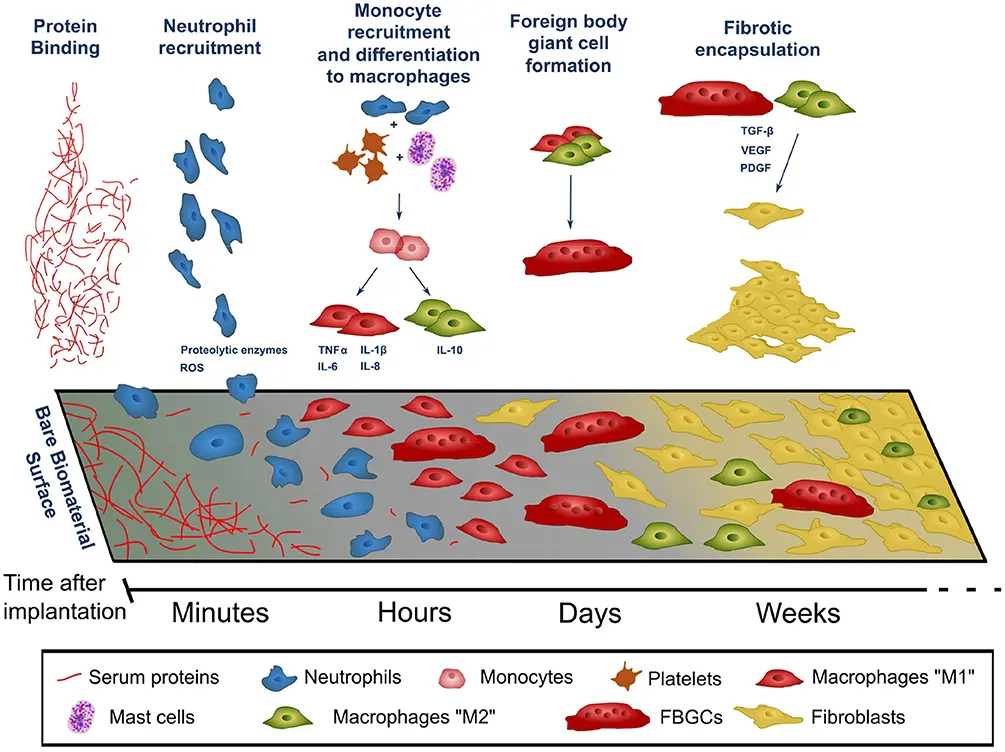
The foreign body reaction (FBR) is a major challenge to long-term neural implant function. When biomedical devices are implanted, the immune system initiates a cascade of cellular responses that ultimately encapsulate the device in fibrotic tissue. This scar tissue physically isolates electrodes from target neurons, degrading signal quality and eventually causing device failure. Our research focuses on understanding and preventing these chronic inflammatory processes to enable lifelong neural interface functionality.
A. Carnicer-Lombarte, S.-T. Chen, G. G. Malliaras, D. G. Barone, Foreign Body Reaction to Implanted Biomaterials and Its Impact in Nerve Neuroprosthetics. Front. Bioeng. Biotechnol. 9, 622524 (2021). DOI:10.3389/fbioe.2021.622524
D. G. Barone, A. Carnicer-Lombarte, P. Tourlomousis et al. Prevention of the foreign body response to implantable medical devices by inflammasome inhibition. Proc. Natl. Acad. Sci. U.S.A. 119, e2115857119 (2022). DOI:10.1073/pnas.2115857119
A. Carnicer-Lombarte et al. Regenerative capacity of neural tissue scales with changes in tissue mechanics post injury. Biomaterials 303, 122393 (2023). DOI:10.1016/j.biomaterials.2023.122393